
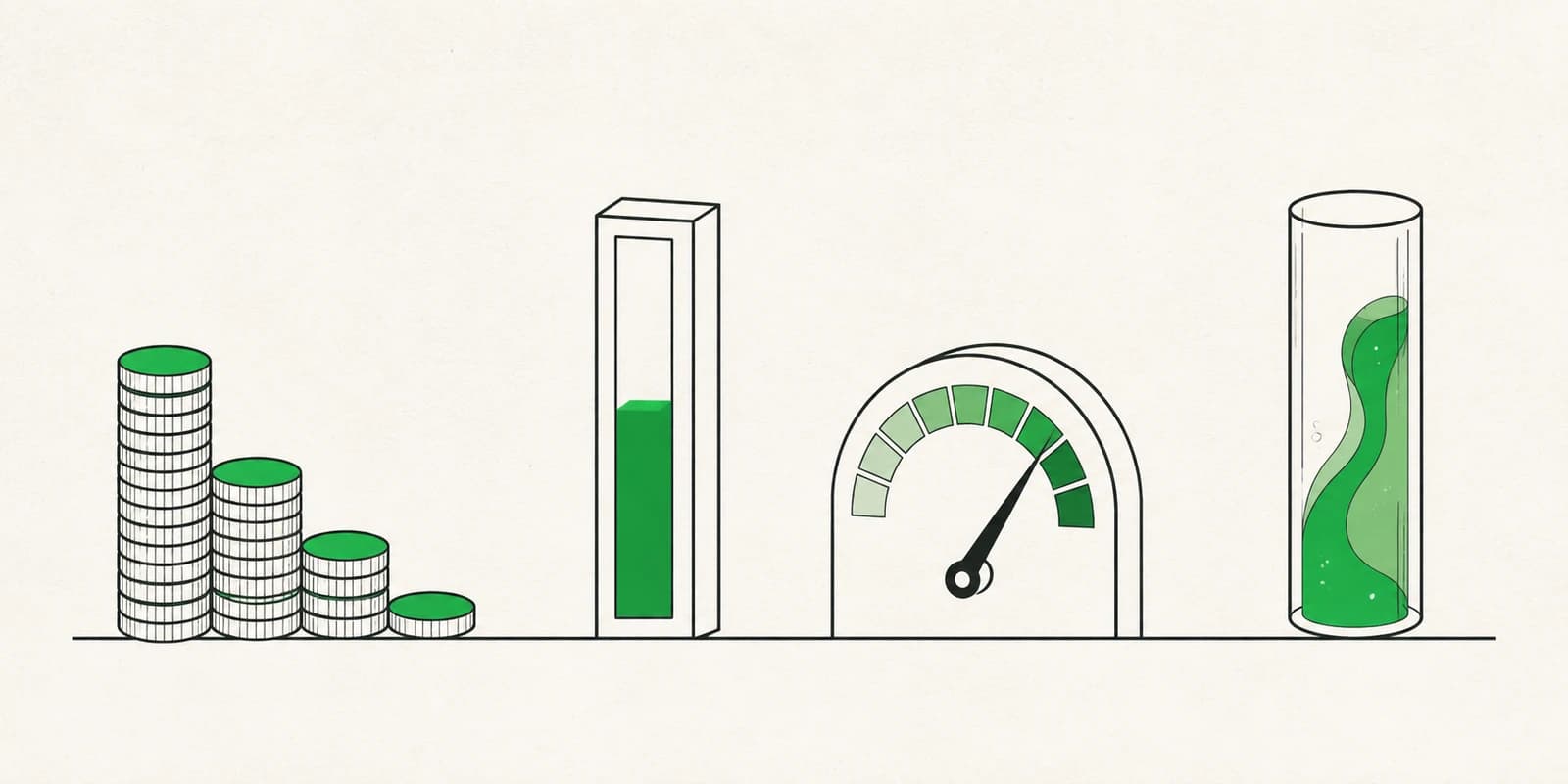
AI chatbot pricing models explained, seats, conversations, credits and metered usage
Support AI is sold four different ways, and the headline price tells you almost nothing until you know which. A breakdown of each model, what makes it expensive, and how to compare them without doing invalid arithmetic.
·6 min read
In short: AI chatbot vendors price in four incompatible ways, per seat, per conversation bundle, per message credit, and per metered usage. Comparing headline prices across models produces a wrong answer, because each model becomes expensive under a different condition. Per-seat pricing punishes team size, conversation bundles punish volume spikes, message credits punish long conversations, and metered usage punishes nothing predictably but is harder to forecast. Work out which variable your business actually grows on, then compare only within that.
The four models
Per seat, per month
You pay for each person with a login, typically $29–$132 per seat per month, and AI answering is often billed separately on top, Intercom, for example, prices its Fin agent at $0.99 per resolved outcome across all seat tiers.
Becomes expensive when: your team grows. The cost is driven by how many people need access, which for support teams is a number that only goes up. It is indifferent to whether those people are busy.
Suits: teams where humans handle most conversations and the AI assists them.
Conversation bundles
You buy a monthly allowance of conversations, Tidio's plans run from a free tier at 50 billable conversations a month, through $24.17/mo for 100, to plans quoted from $49.17/mo for up to 2,000, with AI conversations counted separately from total conversations.
Becomes expensive when: volume is spiky. You size the bundle for your worst month and pay for it in every other month, or you size it for a normal month and get overage charges in the one that matters.
Suits: businesses with steady, predictable contact volume.
Message credits
You buy a monthly pool of message credits, and each bot reply draws one down. Chatbase runs $32/mo for 700 credits, $120/mo for 4,000, and $400/mo for 15,000, with each tier also capping how many separate agents you can run.
Becomes expensive when: conversations are long. A customer who takes eight exchanges to get an answer costs eight times one who takes one, regardless of whether the outcome was any better. It also quietly penalises a bot that asks clarifying questions, often the behaviour you wanted.
Suits: well-scoped bots answering narrow questions in one or two turns.
Bundled AI credits on a flat plan
A flat monthly fee per workspace that includes a fixed dollar value of AI usage. Crisp does this: $45/mo including $5 of AI credits, $95/mo including $25, $295/mo including $75, with the plans stating those amounts as roughly 90, 450 and 1,350 automated conversations respectively.
Becomes expensive when: you exceed the bundle, at which point you are buying usage at whatever the top-up rate is, on top of a fee you already paid.
Suits: predictable volume where the bundle is comfortably above your normal month.
Metered usage
You pay for what the model actually processed, at a published per-model rate, drawn from a balance. This is how ProxyAI works: a one-off price per bot with no seat charge, capabilities bought individually as add-ons, and conversation usage metered against a credit balance.
Becomes expensive when: nothing, predictably, which is also the drawback. There is no ceiling handed to you, so forecasting is on you rather than on the plan. A usage alert is not a nicety in this model; it is the guardrail.
Suits: variable volume, and teams who would rather pay for what happened than for a bundle sized against a guess.
Why comparing headline prices is invalid
A $2 base price and a $29 seat price are not two points on the same axis. One is a per-bot cost that does not move when you hire; the other is a per-person cost that does not move when volume doubles. Any sentence of the form "X is cheaper than Y" is smuggling in an assumption about a volume and a team size that were never stated.
The arithmetic only becomes valid once you fix the variables:
- How many people need a login? This is the only number per-seat pricing cares about.
- How many conversations a month, and how spiky? This decides whether a bundle is a discount or a tax.
- How many turns does a typical conversation take? This is what message credits actually bill.
- What is your worst month, not your average? Bundles are sized against the worst month; metered usage is not.
Answer those four, then compute each vendor's cost for *your* numbers. That comparison is meaningful. The pricing-page comparison is not.
The costs that are not on the pricing page
Setup time. A channel that takes three days of Meta review is a real cost even though it appears on no invoice.
What happens at zero. Some platforms stop answering when a balance runs out. That is arguably correct behaviour, the alternative is an unbounded bill, but it means usage alerts are load-bearing, not optional.
What you lose when you leave. If your knowledge base, instructions and conversation history are not exportable, the switching cost is real and grows monthly. Ask before you commit, not after.
Per-channel fees you do not control. WhatsApp's official route means Meta bills message fees to your own account. That is a cost of the channel, not of the chatbot vendor, and it appears on neither vendor's pricing page.
FAQ
How much does an AI chatbot cost per month?
There is no single figure, because vendors bill in four incompatible ways. Entry pricing across common tools ranges from free tiers with 50 conversations or messages a month, to roughly $24–$45/mo for small bundles, to $29–$132 per seat per month for helpdesk platforms, plus per-resolution AI charges on top in some cases.
What is per-resolution or per-outcome chatbot pricing?
You are billed each time the AI resolves a conversation rather than for each message. Intercom charges $0.99 per Fin outcome, counted when a customer confirms the issue is resolved or does not ask for more help after the AI responds. It aligns cost with results but makes the monthly total depend on how often the bot succeeds.
Is per-seat or usage-based chatbot pricing cheaper?
It depends on which variable your business grows on. Per-seat pricing costs more as the team grows and is indifferent to volume; usage-based pricing costs more as conversation volume grows and is indifferent to team size. A small team handling high volume is cheaper on seats; a larger team handling modest volume is cheaper on usage.
Why do chatbot vendors charge for message credits?
Because each bot reply consumes model inference, which is the vendor's actual variable cost. Credit tiers pass that through in blocks. The side effect is that longer conversations cost more even when the outcome is the same, which mildly penalises bots that ask clarifying questions.
What happens when my chatbot credits run out?
On most metered platforms the bot stops replying until the balance is topped up. This prevents an unbounded bill but means an unnoticed empty balance is a support outage, so usage alerts should be switched on before they are needed.
What hidden costs should I check before choosing a chatbot platform?
Four that rarely appear on pricing pages: setup and verification time for channels like WhatsApp, whether the bot stops at a zero balance, whether your documents and conversation history are exportable if you leave, and per-channel message fees billed by the channel provider rather than the vendor.
Every competitor figure above is quoted from that vendor's own public pricing page, read on 14 August 2026. Pricing changes, the comparison pages carry the sources and the dates, and ProxyAI's own numbers are on services and rates.