
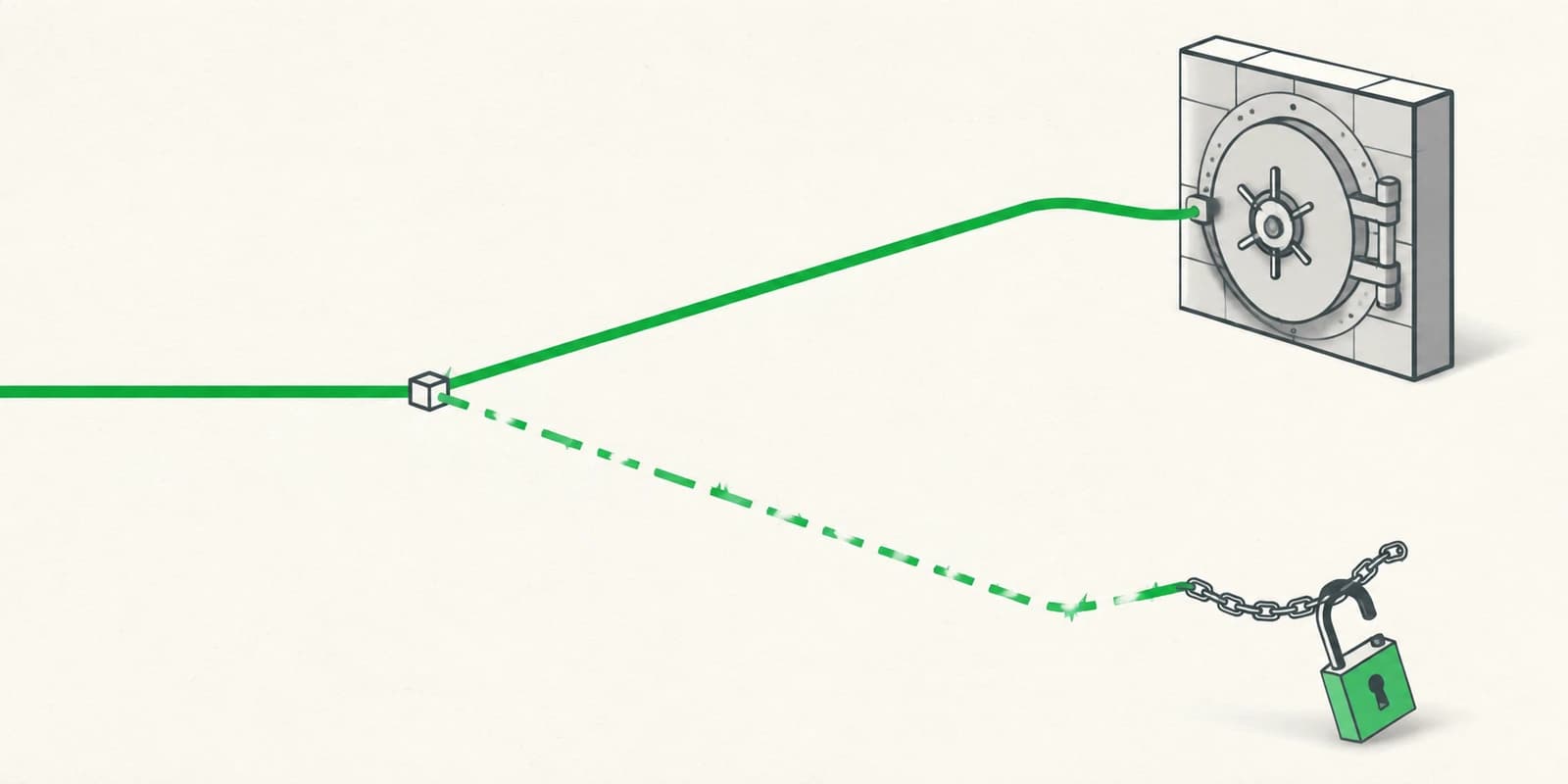
WhatsApp for support, the bridge route and the official route, honestly compared
Linking a WhatsApp number by QR code and going through Meta's Business API are two different products with different failure modes. Which one you want depends on how much you can afford to lose the channel.
·6 min read
In short: there are two ways to put an AI assistant on a WhatsApp number. A bridge links an existing number by scanning a QR code, instant, available in any country, no Meta account, but unofficial and dependent on a phone staying online. The official WhatsApp Business API runs through Meta, is not spontaneously disconnected, and caps unverified businesses at 250 business-initiated conversations per day. Choose the bridge to test the channel; choose the official route once you cannot afford to lose it.
| Bridge (QR pairing) | Official Business API | |
|---|---|---|
| Route | Links an existing number as a device | Meta-sanctioned business account |
| Setup time | Minutes | Days, plus Meta review |
| Meta account required | No | Yes |
| Official support | No | Yes |
| Depends on a phone staying online | Yes | No |
| Can be disconnected by WhatsApp | Yes, at any time | No |
| Message fees | None from Meta | Billed by Meta to your own account |
| Unverified sending cap | Not applicable | 250 business-initiated conversations per day |
There are two ways to put an assistant on a WhatsApp number, and most tools quietly pick one for you. They are not equivalent, they fail differently, and the right answer changes as the business grows. Worth understanding before you commit a number your customers already have.
The bridge route
A bridge links a number you already use by scanning a QR code, the same mechanism WhatsApp Web uses when you pair a laptop. The phone that owns the number stays the owner; the bridge is registered as another linked device.
What it gets you. It works today, in any country, with no Meta account, no business verification and no application to file. Nothing to wait for. If you already run support from a WhatsApp number on someone's phone, this is the shortest path from that to an assistant answering on it.
What it costs you. It is unofficial. WhatsApp can unlink the device at any time, and does, not as punishment, just as a consequence of how linked devices are managed. The phone has to stay online and charged, exactly as with WhatsApp Web: a linked device stops working when the phone stays offline too long.
That is a real operational dependency. A number answering thousands of customers should not depend on whether someone's handset was plugged in overnight.
When it is the right answer. Smaller operations, and any situation where you need to find out whether WhatsApp support is worth doing before investing in the official route. It is genuinely fine for that. Treat it as a channel you could lose on a Tuesday and you will not be caught out.
The official Business API route
The official route runs through Meta. You sign in, choose or create your business and WhatsApp Business account, verify the number, and pick the display name customers see.
What it gets you. A channel Meta knows about and does not spontaneously disconnect. Your WhatsApp Business account stays yours, inside your own Meta business, not held by a vendor on your behalf, which matters the day you change vendors.
What it costs you. Time, and a relationship with Meta's billing. Meta bills message fees to the card on your own account, so your chatbot vendor is not in the middle of that payment, good for transparency, one more thing to set up.
There is also a cap worth planning around: a business that has not completed Meta's verification is limited to 250 business-initiated conversations a day. Customer-initiated conversations are the ones support mostly deals with, so this bites less than it first appears, but if you send proactive order updates, it is the number that will surprise you. Verifying with Meta lifts it, and you do not need to verify anything to begin.
When it is the right answer. When WhatsApp is a channel the business cannot afford to lose. If the answer to "what happens if this number stops working for two days" is anything worse than mild inconvenience, take the official route.
The question that actually decides it
Not volume. Not budget. It is this: is WhatsApp a channel you are testing, or a channel you depend on?
Teams get this wrong in one direction far more often than the other. They start on a bridge because it is quick, the channel works, volume grows, and eighteen months later a substantial share of customer contact runs through an unofficial link to a phone in a drawer. Nobody decided that. It accumulated.
The useful discipline is to set the threshold in advance, a share of contacts, a revenue figure, whatever fits, and migrate when you cross it, rather than when the link drops during a sale.
Migrating between them
Migrating means the number moves to the official route, and that is a Meta-side process rather than something a chatbot vendor can do for you. The assistant configuration, instructions, documents, escalation rules, should carry across untouched, because none of it is channel-specific. If a vendor's WhatsApp setup cannot be detached from the rest of the bot, that is worth knowing before you build on it.
What this does not change
Everything above is transport. What the assistant says, what it knows, when it hands over to a person, and what it costs per answer are the same questions on either route. Pick the transport for its operational risk profile, and spend your actual attention on the answers.
The step-by-step for both routes is in the WhatsApp Connection Guide, and the WhatsApp integration page summarises what connecting involves.
FAQ
Do I need the WhatsApp Business API to use an AI chatbot on WhatsApp?
No. A bridge links a number you already use by scanning a QR code, the same way WhatsApp Web pairs a laptop, and works in any country with no Meta account. It is unofficial, so WhatsApp can unlink the device at any time and the phone that owns the number must stay online.
What is the difference between a WhatsApp bridge and the official Business API?
A bridge registers as a linked device on an existing number and can be disconnected by WhatsApp without notice. The official Business API is a Meta-sanctioned connection that is not spontaneously disconnected, keeps your WhatsApp Business account inside your own Meta business, and bills message fees to your own card.
How many WhatsApp messages can an unverified business send per day?
Meta caps a business that has not completed its verification at 250 business-initiated conversations per day. Customer-initiated conversations, which is most of support, are not what this cap counts. Completing Meta's business verification lifts it.
Who pays WhatsApp message fees?
On the official route Meta bills message fees directly to the card on your own WhatsApp Business account, so your chatbot vendor is not in the middle of that payment. The bridge route has no Meta message fees because it is not going through Meta.
When should I migrate from a WhatsApp bridge to the official API?
When losing the number for two days would be worse than mildly inconvenient. Set that threshold in advance, a share of total contacts, or a revenue figure, and migrate when you cross it, rather than when the link drops during a sale.
Will I lose my chatbot setup if I switch WhatsApp routes?
No, if the platform keeps bot configuration separate from transport. Instructions, documents and escalation rules are not channel-specific, so they carry across unchanged. A vendor whose WhatsApp setup cannot be detached from the rest of the bot is worth identifying before you build on it.